Business Travel and Fieldwork
UZH members who travel abroad on behalf of UZH or temporarily work outside Switzerland can find out here what they need to consider depending on their travel destination with regard to permit requirements, travel preparation, travel insurance and travel assistance. Please follow the steps and information below to comply with UZH travel regulations.
Table of contents
- Travel Destinations and Approval Requirements
- Approval Required: Travel to Areas with Increased Risk
- Travel Insurance
- Travel Assistance
- Travel Preparations for Areas with Increased Risk
- Travel to Countries with High Medical Costs
- Information Security
- Travel to Countries with Special Conditions
- Useful Links
Travel Destinations and Approval Requirements
You can use the travel checklist (DOCX, 97 KB) to prepare for your trip.
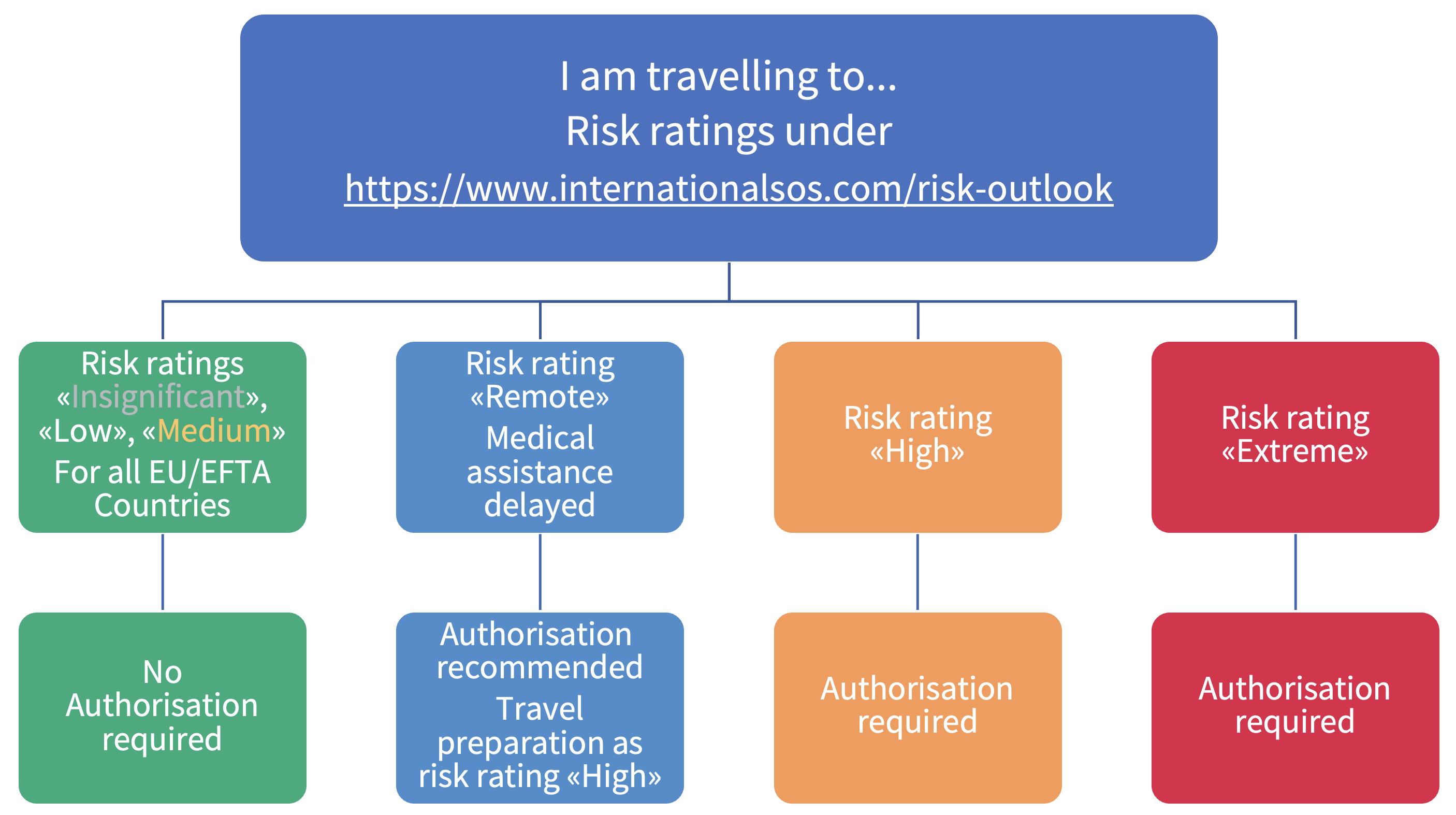
Use the following documents to check the risk classification of your destination country with regard to “security risk”, as published on the International SOS Travel Risk Map. No permit is required for travel and stays abroad in EU/EFTA countries and in countries and regions classified as “Insignificant”, “Low” or “Medium”. For travel to countries and regions classified as “High” or “Extreme”, a permit is required.
The risk classifications for cities and regions within a destination country may vary. Take South Africa, for example: The travel risk is generally “Medium” (no authorization required). However, the travel risk for Johannesburg and Durban is “High” (authorization required). For the risk classification, please consult the following documents:
Risk Map 2026 (PDF, 20 MB)– Global Security & Health Risks
Security risks by country (XLS, 56 KB), broken down by region, You can check the current risk levels here.
Risk Assessment 2026 – Online Country Risk Map
Depending on the risk level of your destination country, you may or may not need a permit for your trip.
Approval Required: Travel to Areas with Increased Risk
Without Approval
No permit is required for travel and stays abroad in EU/EFTA countries and in countries and regions classified as «Insignificant», «Low» or «Medium».
Approval Required: Travel to Areas with Increased Risk
Travel and stays on behalf of UZH in areas classified by International SOS as involving increased risk (“High” or “Extreme” on the Travel Risk Map) must be requested from your supervisor and from the dean of the respective faculty or, in the case of central administrative units, from the relevant director. Before travelling to such areas, a risk assessment must also be obtained from International SOS.
See “Travel Assistance” and “Travel Preparations for Areas with Increased Risk” below.
For travel to areas classified as “Extreme”, separate insurance cover must also be taken out with Chubb. Please contact info@su.uzh.ch for this purpose.
Approval Recommended: Travel to Remote Areas
For travel and stays in remote areas where assistance may be delayed in the event of an emergency, the Executive Board of the University recommends obtaining approval. Travel preparations should be made in the same way as for travel to areas classified as “High”. Delayed and complex emergency assistance in remote areas, where medical care may only be available after several hours, must be taken into account. The category “Remote” is not listed as a risk level on the Travel Risk Map. The assessment is made by travelers themselves or in consultation with info@su.uzh.ch.
Travel Insurance
Insurance Cover
Insurance cover applies to employees, lecturers, doctoral candidates and students who travel abroad as part of their curriculum and on behalf of UZH. Students are not insured, for example, during postgraduate continuing education programs, such as MAS, CAS or DAS programs, semesters abroad, summer schools or mobility programs. Working from home abroad is generally not covered by central travel insurance.
Travel insurance provided by Chubb covers accidents and illness abroad, including medical costs in emergencies abroad and the costs of return transport/repatriation. It also provides insurance cover, for example, for travel cancellation, loss of luggage, and personal injury or property damage (personal liability insurance).
Overview of Chubb travel insurance benefits (valid from 1.9.2026) UZH login required (PDF, 95 KB)
Insurance Confirmation
An insurance confirmation, such as a Travel Insurance Certificate for visa applications, can be generated via the travel insurance website:
https://travelcertificate.chubbinsured.com
Insurance number (policy number): CHBMNA17284
The certificate will be sent to you by email and is password-protected. Password (contract number): CHBMNA17284
Contact in the Event of a Claim
ny damage or costs incurred, such as travel cancellation or theft of luggage, must be reported directly to Chubb travel insurance.
Insurance number: CHBMNA17284, Tel. +49 69 7561 36722
Travel Assistance
Assistance Services
Travel assistance from International SOS includes risk assessment and preparation for travel abroad, provides country-specific travel information and offers support in emergencies and in the event of a claim.
International SOS Assistance App
Download the app. Register with your primary UZH email address, such as felix.muster@uzh.ch, via the UZH login or send your questions to frankfurt@internationalsos.com.
Confirmation of Travel Assistance
A certificate confirming travel assistance from International SOS, the Certificate of Assistance, can be generated via the following website:
https://certificates.internationalsos.com
Membership I.D.: 22AYCA816937
The certificate will be sent to you by email and is password-protected. You will receive the password in a separate email.
Emergency Contact
In emergencies abroad, you can reach travel assistance via the Assistance App.
Alternatively, call one of the following numbers: +49 6102 3588 100 or +41 22 785 64 64
Travel Preparations for Areas with Increased Risk
Travel preparations for areas with increased risk, meaning security risk “High” or “Extreme”, or for remote areas:
| Topic | Fact Sheets, Documents, Links |
|---|---|
| Obtain approval from your supervisor in good time. | Approval from (PDF, 95 KB) |
| Install the FDFA Travel Admin App and register. | FDFA Travel Admin App |
| Install the International SOS Assistance App. To register, you must use your primary UZH email address with UZH login, such as felix.muster@uzh.ch. | Assistance App |
| Forward bookings, such as flights and hotels, to uzhtravel@itinerary.internationalsos.com to receive real-time security and health alerts. This also enables UZH to contact you in the event of a crisis. Further information: Tutorial International SOS Benefits. | |
| Consult detailed country-specific travel information. Go to the International SOS membership login. | Membership Login for travel preparation |
| Review the regulations on export controls, sanctions, and embargoes. These regulations govern, in particular, the cross-border exchange of goods, technologies, and software for both civilian and military purposes (dual-use goods), as well as military equipment and chemicals. For more information, click here. | More information below under "Sanctioned Countries". |
| Register on the International SOS e-learning platform for travel preparation and complete the e-learning modules relevant to you, such as Introduction to Membership, Travel Risk Awareness – Medical, Travel Risk Awareness – Security and Road Safety. | E-Learnings |
| For travel information, such as vaccinations or travel restrictions, contact the International SOS Assistance Center. You can obtain free travel information as well as a risk assessment tailored to your trip from International SOS by sending an email request. |
frankfurt@internationalsos.com Frankfurt phone: +49 6102 3588 |
| Print out the International SOS Subscription Card and carry it with you at all times, for example in your wallet. Add the Subscription Card to your smartphone wallet via the profile menu in the Assistance App. | International SOS Subscrition Card (PDF, 468 KB) |
| For further questions, please contact Safety, Security and Environment. | info@su.uzh.ch |
Travel to Countries with High Medical Costs
In order to ensure insurance cover for countries with high medical costs, such as the USA, Canada, Japan or Australia, specific travel preparations must be made. In the event of illness or medical emergencies, International SOS must be contacted via the Assistance App or by phone to ensure optimal support. This allows, for example, guarantees of payment to be issued.
Travel Preparation
- Install the International SOS Assistance App. To register, you must use your primary UZH email address with UZH login, such as felix.muster@uzh.ch.
- Print out the International SOS Subscription Card (PDF, 468 KB) and carry it with you at all times, for example in your wallet. Add the Subscription Card to your smartphone wallet via the profile menu in the Assistance App.
Information Security
Information security is also important when traveling to ensure that your data and information are protected (e.g., confidential research data). To ensure that travel preparations can be carried out safely, a model was developed to assess risks. The UZH information security model is based on freely available indices on risk topics and classifies countries into three risk levels, for each of which tailored security measures are recommended.
Travel to Countries with Special Conditions
Sanctioned Countries
For travel and stays on behalf of UZH in the sanctioned countries/regions Iran, Syria, North Korea, (North) Sudan, Myanmar, Cuba, Venezuela, Russia as well as the Ukrainian regions Crimea, Sevastopol, Donetsk, Luhansk, Cherson and Zaporizhzhia the following must be considered:
- The Export Control Office must be contacted to verify sanctions, embargoes, and export control regulations, rechtsdienst@rud.uzh.ch. Please review the relevant information and guidelines beforehand.
- After the internal review by the Export Control Office and at least one week before departure, a sanctions check must be conducted via “Chubb”. Contact certificates-CH@Chubb.com
Travel by Members of the LGBTIQ Community
The laws and political measures of some countries can significantly affect the safety of members of the LGBTIQ community or involve significant risks during a stay. Many countries criminalize same-sex sexual orientation. Trans or non-binary travelers may encounter difficulties when entering certain countries if they present a passport with a name and photo that no longer correspond to their gender identity or that indicates their gender as “diverse” or “X”. Displaying LGBTIQ symbols, such as the rainbow flag, may also be illegal in the destination country.
The ILGA world map provides a comprehensive overview of safety. A specific risk assessment via the International SOS Assistance App is recommended. Current information on travel to the USA can be found in the International SOS country reports.
Further recommendations on conduct are available from the Federal Foreign Office of Germany.
Useful Links
| Topic | Fact Sheets, Documents, Links |
|---|---|
| Travel Medicine Consultation (Vaccinations, Malaria Prevention) | Travel Clinic UZH |
| FDFA, Federal Department of Foreign Affairs | |
| Federal Foreign Office of Germany | Travel safely App |
| French Ministry for Europe and Foreign Affairs | Travel advise |
| LGBTIQ people | Website ILGA |
| Security guidelines for field research in complex, remote and hazardous places | Guidelines |
| ADVANCEing FieldSafety (AFS) |
Please note that UZH internal directives and regulations, such as the Gender Policy, Code of Conduct, Protection against Sexual Harassment at UZH, also apply to business travel and fieldwork.